|
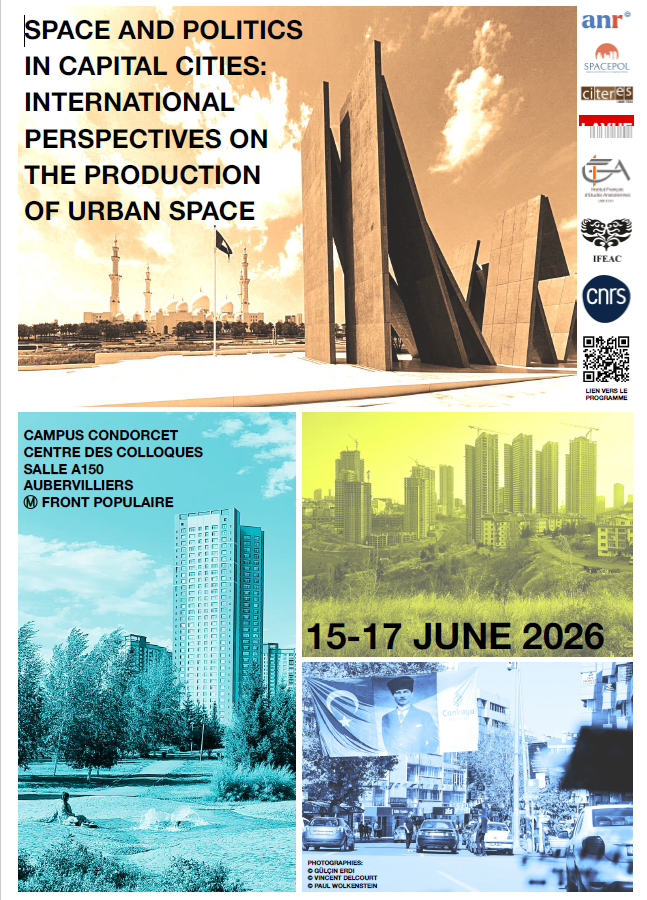
15-17 Jun 2026 Paris Campus Condorcet (France)
|
|
|
|
|
Project Presentation National capitals serve as the seat of central government, its principal institutions, and key state organisations, and as such occupy a distinctive political and symbolic position at national, regional, and global scales. They are expected to embody and project the identity of the state, to give spatial expression to prevailing conceptions of nationhood, and to reflect, as much as to shape, the political order of the societies they represent. Yet despite their singular importance, capital cities remain comparatively understudied in the urban literature, particularly with regard to how their design, planning, and built environment participate in the production and representation of political power. The SPACEPOL Conference addresses this gap at an opportune moment, bringing together new research on capital cities with a particular emphasis on contexts from the Global South and authoritarian political settings. The capital is, above all, the privileged site where political power is exercised and where the tensions inherent in the political field are most visibly enacted. It is where parties compete for authority, where state and non-state actors seek to inscribe their respective visions into urban form, and where divergent interests, representations, and political imaginaries come into conflict. Even under authoritarian conditions, it remains a space where governmental decisions are contested (by civil society, organised labour, or ordinary citizens) and where the question of who governs, and on whose terms, is continually posed and renegotiated. The material fabric of the capital city plays a central role in these dynamics. Architecture, monuments, and urban planning produce built environments that function simultaneously as instruments of power and as a shared symbolic vocabulary addressed to the nation as a whole. Yet the very coherence of this symbolic register is permanently undermined by the power struggles and social tensions it seeks to contain: the dominance of particular groups, classes, or regions, and the plurality of competing frames of reference, inevitably fracture the narrative of harmony and national unity that the symbolism of capital cities strives to project. The capital must therefore be understood not merely as a stage for the performance of power, but as a contested terrain on which multiple actors continuously struggle to define its meaning. This raises a fundamental question: how is power spatially expressed, claimed, and contested across the capital city? The symbolic dimension of urban space is both an object and an instrument of power. Those who control the production of symbols exercise an indirect yet potent influence over processes of collective identification, and thereby over the social constitution of the groups whose consent legitimises the exercise of political authority. This conference proceeds from a deliberate methodological choice: to examine capital cities on their own terms, resisting the impulse to measure them against the benchmarks established by hegemonic frameworks centred on so-called global cities. For too long, cities of Asia and the Middle East were positioned within the metanarrative of global urbanism as subordinate peripheries relative to the metropolitan cores of the Western world. The recent turn in urban studies toward theoretical engagement with diverse global contexts has begun to correct this imbalance: cities outside the Western tradition are now studied in their own right, rather than as mere empirical anomalies or deficient approximations of a Western urban ideal (Peck, 2015; Parnell & Oldfield, 2014). The presentations gathered in this conference draw on the SPACEPOL research project, funded by the French National Research Agency (ANR) under agreement number ANR-21-CE22-0023, and focused on six capital cities: Ankara, Moscow, Tehran, Abu Dhabi, Astana, and Cairo. The selection rests on the observation that, while these capitals frequently appear in the literature on international relations and geopolitics, they remain substantially underexplored in urban studies, particularly with respect to how political regimes shape and instrumentalise urban space. The six cities were chosen for their diverse yet structurally comparable political configurations, all of which exhibit authoritarian or illiberal characteristics. They also share significant commonalities in terms of socio-economic dynamics, transnational flows, and the ways in which governing authorities mobilise urban space to project power and manufacture legitimacy. A large-scale comparative data collection effort across these six cities has been undertaken to examine both convergences and divergences in their urban planning strategies and governance arrangements. The diversity of the selected cases, in terms of size, geopolitical significance, and trajectories of urbanisation, provides a productive basis for exploring the extent to which authoritarian governance shapes urban development and the spatial grammar of power. Rather than ranking these capitals within pre-established urban hierarchies, the conference invites reflection on their specificities and mutual interactions. As Scott and Storper (2015) have argued, the theoretical contribution of studying non-Western cities cannot rest solely on the empirical differences they exhibit relative to cities of the Global North. It must emerge, more profoundly, from the new and hitherto unsuspected insights that the study of urbanisation in these contexts may yield concerning the inner logic of urban agglomeration processes and associated dynamics, insights capable of enriching, and where necessary revising, existing theoretical frameworks developed in and for the Global North. Finally, the conference addresses a question that has received insufficient attention in the urban literature: whether the policy-making processes governing capital cities in centralised and authoritarian states follow trajectories analogous to those observed in Western democratic contexts, or whether the massive investment directed at capital cities in such settings constitutes a distinct political strategy, one oriented toward enhancing national prestige and consolidating regional influence (Fawaz, 2009; Florin et al., 2014). More broadly, it invites consideration of whether authoritarian politics fundamentally conditions urban development, or whether political actors across different regime types converge toward a shared rationality of urban image management within a global governance landscape increasingly structured by neoliberal norms. Particular attention will be paid to the visible and invisible antagonisms among actors operating at multiple scales, from the local to the national, and to the ways in which these tensions are inscribed in, and mediated through, urban space. References Fawaz, M. (2009). Neoliberal urbanity and the right to the city: A view from Beirut's periphery. Development and Change, 40(5), 827–852.
Parnell, S. & Oldfield, S. (Eds.). (2014). The Routledge handbook on cities of the Global South. Routledge.
Peck, J. (2015). Cities beyond compare? Regional Studies, 49(1), 160–182.
Scott, A. J. & Storper, M. (2015). The nature of cities: The scope and limits of urban theory. International Journal of Urban and Regional Research, 39(1), 1–15.
Projects's Website: https://spacepol.hypotheses.org/
|